Read a Short History of Nearly Everything
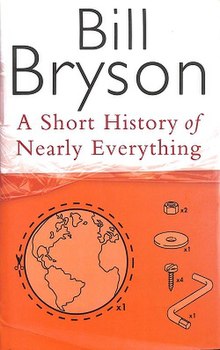 First edition (UK) | |
| Author | Bill Bryson |
|---|---|
| Language | English language |
| Genre | Not-fiction |
| Publisher | Doubleday (United kingdom) Broadway Books (US) |
| Publication engagement | 2003 |
| Media blazon | Impress (Hardcover, Paperback, E-Book) |
| ISBN | 0-7679-0817-1 |
| OCLC | 51900381 |
| Dewey Decimal | 500 21 |
| LC Course | Q162 .B88 2003 |
A Short History of Most Everything past American-British author Bill Bryson is a popular science book that explains some areas of science, using hands accessible language that appeals more to the general public than many other books dedicated to the subject area. It was one of the bestselling pop science books of 2005 in the United Kingdom, selling over 300,000 copies.[1]
A Curt History deviates from Bryson'south popular travel book genre, instead describing general sciences such as chemistry, paleontology, astronomy, and particle physics. In it, he explores fourth dimension from the Big Bang to the discovery of breakthrough mechanics, via evolution and geology.
Background [edit]
Bill Bryson wrote this book because he was dissatisfied with his scientific knowledge—that was, not much at all. He writes that science was a afar, unexplained field of study at school. Textbooks and teachers alike did non ignite the passion for cognition in him, mainly because they never delved in the whys, hows, and whens.
"It was equally if [the textbook writer] wanted to keep the skilful stuff secret by making all of information technology soberly unfathomable."
—Bryson, on the state of science books used within his school[2]
Contents [edit]
Bryson describes graphically and in layperson's terms the size of the universe and that of atoms and subatomic particles. He and then explores the history of geology and biological science and traces life from its kickoff advent to today's mod humans, placing accent on the evolution of the modern Human sapiens. Furthermore, he discusses the possibility of the Earth being struck by a meteorite and reflects on human capabilities of spotting a meteor before it impacts the Earth, and the extensive damage that such an event would cause. He also describes some of the near recent subversive disasters of volcanic origin in the history of our planet, including Krakatoa and Yellowstone National Park.
A large part of the volume is devoted to relating humorous stories near the scientists behind the research and discoveries and their sometimes eccentric behaviours. Bryson besides speaks about modernistic scientific views on human effects on the Globe'south climate and livelihood of other species, and the magnitude of natural disasters such as earthquakes, volcanoes, tsunamis, hurricanes, and the mass extinctions caused past some of these events.
An illustrated edition of the volume was released in November 2005.[3] A few editions in audiobook grade are also bachelor, including an abridged version read past the author, and at to the lowest degree three entire versions.
Awards and reviews [edit]
The book received more often than not favourable reviews, with reviewers citing the book as informative, well-written, and entertaining.[4] [5] [6]
In 2004, this book won Bryson The Aventis Prizes for Scientific discipline Books for best general science book.[7] Bryson later on donated the GBP£10,000 prize to the Great Ormond Street Infirmary children'southward charity.[8]
In 2005, the book won the EU Descartes Prize for science advice.[9] It was shortlisted for the Samuel Johnson Prize for the same twelvemonth.
See too [edit]
- Big History
References [edit]
- ^ Staff of BBC Focus (July 2006). "How to... Make a Mint From Scientific discipline". BBC Focus: 54.
- ^ Bryson, Bill (May 2003). A Brusk History of Nearly Everything . Usa: Broadway Books. ISBN0-7679-0817-1.
- ^ Bryson, Nib (November 2005). A Curt History of Nearly Everything: Special Illustrated Edition . Broadway Books. ISBN0-7679-2322-7.
- ^ Waller, John (June 21, 2003). "Everything you've ever wanted to know (but didn't dare inquire)". The Guardian. Archived from the original on March 12, 2017. Retrieved June 30, 2018.
- ^ "A Volume Review of: A Brusk History of Nearly Everything by Bill Bryson – Broadway Books, 2003". Jupiter Scientific. 2004. Archived from the original on December 21, 2017. Retrieved June xxx, 2018.
- ^ Ayers, Kate (Jan 23, 2011). "Review – A Short History of Well-nigh Everything". Bookreporter.com. Archived from the original on August 8, 2017. Retrieved June 30, 2018.
- ^ Amos, Jonathan (June 14, 2004). "Bryson wins £10,000 scientific discipline prize". BBC News. Archived from the original on January 25, 2018. Retrieved March xv, 2006.
- ^ Crown, Sarah (June 22, 2004). "Bryson gives away Aventis winnings". The Guardian. Archived from the original on June thirty, 2018. Retrieved June 30, 2018.
- ^ Pauli, Michelle (December vii, 2005). "Bryson wins Descartes prize for his guide to science". The Guardian. Archived from the original on June xxx, 2018. Retrieved June 30, 2018.
External links [edit]
- Neb Bryson – A short history of most everything presentation at the Imperial Guild
- Interview with Mariella Frostrup (BBC Radio 4)
Source: https://en.wikipedia.org/wiki/A_Short_History_of_Nearly_Everything
0 Response to "Read a Short History of Nearly Everything"
Post a Comment