The Diary of Anne Frank Is One of the Most Widely Read Books of
| Anne Frank | |
|---|---|
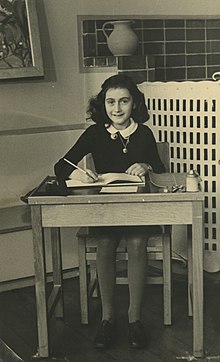 Anne Frank | |
| Born | Annelies Marie Frank (1929-06-12)12 June 1929 Frankfurt am Main, Weimar Germany |
| Died | February 1945 (aged xv)[1] Bergen-Belsen concentration campsite, Lower Saxony, Nazi Frg |
| Nationality | High german until 1941 Stateless from 1941 |
| Notable works | The Diary of a Immature Girl (1947) |
| | |
| Signature |  |
Annelies Marie Frank (12 June 1929 in Frankfurt am Main – February 1945[one] in Bergen-Belsen) is one of the most famous Jewish people who died in the Holocaust.[2] Her diary is seen as a archetype in state of war literature, and is ane of the virtually widely read books today. Several plays and movies have been fabricated about it.
Anne was built-in in the urban center Frankfurt am Principal in Weimar Germany. She lived almost of her life in or around Amsterdam, in holland. She was officially seen as a German until 1941. This was when she lost her nationality because of the anti-Semitic rules of Nazi Federal republic of germany. She became famous around the earth subsequently her death when her diary was printed. In it she described her experiences hiding during the Nazi German occupation of the Netherlands in World State of war II.
The Frank family moved from Federal republic of germany to The netherlands's capital, Amsterdam in 1933. This was the same yr that the Nazis grew powerful in Deutschland. By the beginning of 1940, because of the Nazi occupation of the Netherlands, the Frank family was trapped in Amsterdam. Persecution of Jewish people increased in July 1942, and the family decided to hide. They hid in some secret rooms of her male parent Otto Frank's function edifice. Later two years, they were betrayed and taken to concentration camps. Anne and her sister, Margot, were afterwards taken to the Bergen-Belsen concentration camp. At that place, they both died from typhus in February 1945.[ane]
Otto Frank was the only person in his family who survived. He went dorsum to Amsterdam subsequently the state of war and plant that Anne's diary had been saved. He helped impress a version of information technology in 1947. It was translated from Dutch and first printed in English in 1952 every bit The Diary of a Young Daughter. Information technology has been translated into many languages. The diary had been given to Anne on her 13th birthday. In it she wrote of her life from 12 June 1942 until 1 August 1944.
Anne Frank was born on 12 June 1929 in Frankfurt, Germany. She was the second girl of Otto Frank (1889–1980), a German businessman,[two] and Edith Frank-Holländer (1900 – 45). Margot Frank (1926–45) was her older sister.[3] The Franks were Jews, and they lived with many Jewish and non-Jewish citizens. Anne and Margot grew up with Catholic, Protestant, and Jewish friends. The Frank family did not follow all the customs of Judaism.[4] Edith Frank was very religious, though her husband was more interested in studying. He had a big library, and both parents encouraged the children to read.[5]
On xiii March 1933, elections were held in Frankfurt, and Adolf Hitler'due south Nazi Party won. Acts of Antisemitism began almost immediately. The Franks were afraid of what might happen to them if they stayed in Deutschland. Therefore, afterwards that year, Edith and the children went to Aachen. They stayed there with Edith's mother, Rosr.a Hollände Otto remained in Frankfurt, but after getting an offer to starting time a company in Amsterdam, he moved in that location to begin the business organisation and to discover a place to alive with his family.[6] The Franks were included in the 300,000 Jews who ran abroad from Germany betwixt 1933 and 1939.[7]
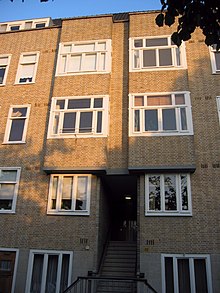
The apartment block on the Merwedeplein where the Frank family lived from 1934 until 1942
Otto Frank began working at the Opekta Works. Opteka was a company that sold pectin. Otto Frank found an apartment on the Merwedeplein (Merwede Foursquare) in Amsterdam. Past February 1934, Edith and the children had arrived in Amsterdam, and Anne and Margot began going to school. Margot went to public schoolhouse and Anne went to a Montessori schoolhouse. Margot enjoyed math, while Anne preferred reading and writing. Her friend Hanneli Goslar subsequently remembered that from when she was immature, Anne frequently wrote, though she tried to hide what she wrote and did not like talking about it. Margot and Anne had very dissimilar personalities. Margot was polite, quiet, and thoughtful,[8] while Anne was brave, energetic, and friendly.[nine]
In 1938, Otto Frank started a second visitor, Pectacon. Pectacon sold herbs, salts and mixed spices that were used to brand sausages.[10] [11] Hermann van Pels worked at Pectacon as a helper almost spices. He was a Jewish butcher.[11] In 1939, Edith'southward female parent came to live with the Franks. She stayed with them until she died in Jan 1942.[12]
In May 1940, Germany invaded the Netherlands. The authorities began to hurt Jews past making rules and laws almost their freedom. The Frank sisters were both studying well and had many friends. Just a new law that Jewish children could merely get to a Jewish school made them move to a Jewish schoolhouse.[12] The companies that Otto Frank worked at still gave him some money, but they became poorer. Information technology was not plenty to back up their family unit.[xiii]
Before hiding [change | alter source]
For her 13th birthday on 12 June 1942, Anne Frank got a volume she had shown her father a few days before. It was really an autograph book with red-and-white cloth and a small lock on the forepart, only Anne decided to use it equally a diary.[14] She began writing in it almost immediately. Nearly of her first writings are nigh normal parts of her life, simply she also wrote most some other things.
In July 1942, the Zentralstelle für jüdische Auswanderung (Central Part for Jewish Emigration) ordered Margot Frank to come up to exist taken to a piece of work camp. Otto Frank told his family that they would hide in rooms above and behind the place where his company worked on the Prinsengracht. The Prinsengracht was a street next to 1 of Amsterdam's canals, where some of his most trusted employees would help them. The notice to Margot made them move a few weeks earlier than they had expected.[15]
Hiding [change | alter source]
Anne'due south father, Otto Frank, was scared that the Nazis would observe him and his family which he needed to protect, he and so spoke to some of the people who worked in his business organization. 1 of them was a immature woman of about 33 years old, and was named Miep Gies. He told her he needed help - he was going to turn the meridian floor of his business into a hole-and-corner hiding identify for himself and his family chosen "The Secret Annex". Miep and the others would have to help them keep their clandestine, and bring them food. They hid in their hugger-mugger hiding place for ii whole years, without being discovered by the Nazis. Anne Frank left all her other belongings in Frankfurt.
Miep agreed to help. In 1942, the Frank family, together with the Van Pels (And their son Peter) and a dentist named Fritz Pfeffer, moved into the Hole-and-corner Addendum that they had prepared. They planned to stay at that place until the end of the war. They hoped the war would end soon, but information technology did not. They spent around two and a half years in their hiding identify, never able to go out into the sunshine. During the solar day, the family unit had to exist very tranquility, considering the business continued downstairs, and non all the workers knew that the Frank family was in hiding in the upper function of the edifice.
A few months before the Franks went into hiding, Anne was given a diary, for her birthday. She called her diary "Kitty" and wrote in it nearly all the things that were happening to her and to her family. Anne was only a young girl, merely she knew how to write beautifully. She wrote about all the things that young girls think about - how she was getting along with her friends and parents, boys (pretty much Peter), her life and emotions. Afterwards a while, Anne had i strong appetite, she aspired to be a author. She hoped to write a book that everyone would read.
A total of 78 families lived hiding in the same edifice which was a total of 700 people.
Later 2 years a thief had come and took not much, merely afterwards virtually ii and a half years in hiding, non long earlier the end of the state of war, the thief was caught and, in exchange of not going to jail or death, he told the Nazis that a Jewish family - the Franks - were in hiding. Nazi soldiers came into the Frank'due south secret hiding place. They sent the Franks and the others to a concentration camp. Miep Gies constitute Anne'southward diary and put it into a drawer. She wanted to proceed it safe until after the war. She hoped that Anne would return, and she would be able requite her her diary back to her.
Nevertheless, that was not to be. Anne's father, Otto Frank, lived through the war and came back to Amsterdam. He hoped that his family unit had survived besides - just they had not. Of all the family, only he survived. His wife was killed at Auschwitz. Anne and her older sis, Margot, died at Bergen-Belsen concentration army camp from typhus, a disease - but a calendar month earlier the camp was freed past the Allied forces. When he got out, he establish Anne's diary and published it.[1]
Diary [change | change source]
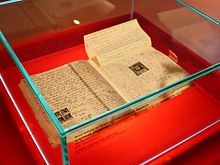
When World State of war II ended, Miep Gies gave Otto Frank Anne's diary and a bundle of notes. Otto Frank then decided to publish her diary to commemorate her.
Miep Gies was with Otto Frank when he got the letter of the alphabet telling him that his two daughters were dead. Now she knew that Anne would never return for her diary. She went to the drawer where the diary was kept, and she gave it to Otto Frank. People who were close to Anne read the diary. They told Otto Frank that he should publish it. Anne had wanted to be a famous author. Now, people would exist able to read her book, and they would likewise learn virtually the difficult fourth dimension that the Jews had during the war, and nearly the wonderful people who helped them.
Otto had Anne's diary printed. It became one of the globe'due south most widely-read books. It has been printed in over 60 languages, and people across the globe take read and enjoyed this truthful story. Today, for an admissions fee, you can visit the house in Amsterdam where Anne Frank and her family hid during the war. You tin can also see the diary that she wrote.
Notes and references [change | modify source]
- ↑ 1.0 ane.one ane.2 i.iii Research by The Anne Frank House in 2022 revealed that Frank may take died in Feb 1945 rather than in March, as Dutch government had long assumed. "New research sheds new light on Anne Frank's last months". AnneFrank.org, 31 March 2015
- ↑ ii.0 ii.1 "Encyclopædia Britannica's Reflections on the Holocaust". britannica.com . Retrieved 23 June 2010.
- ↑ Müller 1998, preface: Family tree
- ↑ Van der Rol and Verhoeven, p. 10
- ↑ Lee 2000, p. 17
- ↑ Lee 2000, pp. 20–23
- ↑ Van der Rol and Verhoeven, p. 21
- ↑ Müller 1998, p. 131
- ↑ Müller 1998, pp. 129–35
- ↑ Müller 1998, p. 92
- ↑ 11.0 11.i Lee 2000, p. forty
- ↑ 12.0 12.one Müller 1998, pp. 128–130
- ↑ Müller 1998, pp. 117–118
- ↑ Lee 2000, p. 96
- ↑ Müller 1998, p. 153
Bibliography [change | alter source]
- Frank, Anne (1995) [1947]. Frank, Otto H.; Pressler, Mirjam (eds.). Het Achterhuis [The Diary of a Young Girl - The Definitive Edition] (in Dutch). Massotty, Susan (translation). Doubleday. ISBN0-553-29698-1. ; This edition, a new translation, includes material excluded from the earlier edition.
- Frank, Anne and Netherlands State Establish for State of war Documentation (1989). The Diary of Anne Frank, The Critical Edition. Doubleday. ISBN 0-385-24023-6.
- Lee, Carol Ann (2000). The Biography of Anne Frank - Roses from the Earth. Viking Printing. ISBN0-7089-9174-2.
{{cite book}}: CS1 maint: ref duplicates default (link) - Müller, Melissa (1999) [1998]. Das Mädchen Anne Frank [Anne Frank: The Biography] (in German). Kimber, Rita and Robert (translators). Henry Holt and Visitor. ISBN0-7475-4523-v. OCLC 42369449. ; With a note from Miep Gies.
- van der Rol, Ruud; Verhoeven, Rian (for the Anne Frank House); Quindlen, Anna (Introduction); Langham, Tony & Peters, Plym (translation) (1995). Anne Frank - Beyond the Diary - A Photographic Remembrance. Puffin. ISBN 0-14-036926-0.
- Westra, Hans; Metselaar, Menno; Van Der Rol, Ruud; Stam, Dineke (2004). Within Anne Frank's House: An Illustrated Journeying Through Anne's World. Overlook Duckworth. ISBN ane-58567-628-4.
Other websites [change | modify source]
-
 Media related to Anne Frank at Wikimedia Commons
 - "Anne Frank Museum Amsterdam - the official Anne Frank House website". annefrank.org . Retrieved 18 June 2010.
- "Anne Frank-Fonds". annefrank.ch . Retrieved 18 June 2010.
Source: https://simple.wikipedia.org/wiki/Anne_Frank
0 Response to "The Diary of Anne Frank Is One of the Most Widely Read Books of"
Post a Comment