How Can I Sell My 21/2 Dollar Gold Coin Nassau County Ny Upload My Coins

A gold coin is a coin that is made mostly or entirely of gold. Virtually gold coins minted since 1800 are 90–92% gold (22 karat), while most of today's gold bullion coins are pure aureate, such as the Britannia, Canadian Maple Leaf, and American Buffalo. Alloyed gold coins, like the American Gilded Eagle and South African Krugerrand, are typically 91.7% gold by weight, with the residuum being silver and copper.
Traditionally (up to about the 1930s), aureate coins take been apportionment coins, including coin-like bracteates and dinars. In recent decades, nevertheless, gold coins are mainly produced equally bullion coins for investors and as commemorative coins for collectors. While modern gilt coins are nonetheless legal tender, they are non observed in everyday fiscal transactions, as the metal value normally exceeds the nominal value. For example, the American Gold Eagle has a denomination of ten USD, but a metal value of more than $800 USD (being around a half an ounce).
The gilded reserves of central banks are dominated by gold bars, but aureate coins may occasionally contribute.
Gilt has been used as money for many reasons. It is fungible, with a low spread between the prices to buy and sell. Gold is also hands transportable, as it has a loftier value-to-weight ratio compared to other bolt such as silver. Gold can be re-coined, divided into smaller units, or melted into larger units such as gold bars, without destroying its metal value. The density of aureate is higher than most other metals, making it difficult to pass counterfeits. Additionally, gold is extremely unreactive chemically: it does not tarnish or corrode over time.
History [edit]
Artifact [edit]


Gold was used in commerce (beside other precious metals) in the Ancient Near East since the Statuary Age, simply coins proper originated much subsequently, during the 6th century BC, in Anatolia. The name of king Croesus of Lydia remains associated with the invention (although the Parian Chronicle mentions Pheidon of Argos as a contender). In 546 BC, Croesus was captured by the Persians, who adopted gilded as the primary metal for their coins. The most valuable of all Persian minted coinage still remains the gold drams[ clarification needed ], minted in 1 Advert as a gift by the Persian King Vonones (Matthew two.1–23).[i] [2] Ancient Greek coinage contained a number of golden coins issued past the various city states.
The Ying yuan is an early gilded coin minted in ancient Cathay. The oldest ones known are from almost the 5th or sixth century BC.
Larger units such as the various talent measures (26 to up to sixty kg) were used for high value exchanges (similar to today's 400-troy-ounce (12.4 kg) "good delivery" gold bullion bar).
Middle Ages and Early Modern period [edit]
Modern history [edit]
The German gold mark was introduced in 1873 in the German Empire, replacing the various local Gulden coins of the Holy Roman Empire.
Aureate coins and then had a very long menses as a primary grade of money, but falling into disuse in the early 20th century. Almost of the world stopped making gold coins as currency past 1933, every bit countries switched from the gilded standard due to hoarding during the worldwide economic crisis of the Not bad Low. In the Us, 1933's Executive Order 6102 forbade the hoarding of gold and was followed past a devaluation of the dollar relative to golden, although the United states of america did non completely uncouple the dollar from the value of gold until 1971.[3]
Gold-colored coins have made a comeback in many currencies. Notwithstanding, "gilt coin" (in numismatic terminology) e'er refers to a coin that is (more than or less) made of gilt, and does not include coins made of manganese brass or other alloys. Furthermore, many countries proceed to brand legal tender gold coins, but these are primarily meant for collectors and investment purposes and are not meant for apportionment.
Collector coins [edit]

Many factors determine the value of a gold coin, such as its rarity, historic period, condition and the number originally minted. Most aureate coins minted since the late 19th century are worth slightly more spot toll, but many are worth significantly more. Gold coins coveted by collectors include the Aureus, Solidus and Spur Ryal.
In July 2002, a very rare $20 1933 Double Eagle aureate coin sold for a record $vii,590,020 at Sotheby's, making it past far the most valuable money always sold up to that time (a 1794 Flowing Hair Dollar sold for over $ten 1000000 in January 2013). In early 1933, more than 445,000 Double Eagle coins were struck by the U.S. Mint, merely most of these were surrendered and melted downwardly following Executive Order 6102. Only a few coins survived.
In 2007 the Majestic Canadian Mint produced a 100 kilograms (220 lb) gold coin with a face value of $1,000,000, though the gold content was worth over $2 million at the time. It measures 50 centimetres (xx in) in diameter and is 3 centimetres (1.2 in) thick. Information technology was intended as a one-off to promote a new line of Canadian Golden Maple Leafage coins, simply after several interested buyers came forrad the mint appear it would manufacture them as ordered and sell them for betwixt $ii.5 one thousand thousand and $iii one thousand thousand. Equally of May three, 2007, there were five orders.[4] Ane of these coins was stolen when it was on exhibition at the Bode Museum in Berlin.[5]
Austria had previously produced a 37 centimetres (xv in) diameter 31 kg Philharmonic golden money with a face value of €100,000.
On October 4, 2007, David Albanese (president of Albanese Rare Coins) stated that a $10, 1804-dated hawkeye coin (fabricated for President Andrew Jackson as a diplomatic gift) was sold to an anonymous individual collector for $5 one thousand thousand.
In 2012 the Royal Canadian Mint produced the world first gold coin with a 0.11–0.14ct diamond. The Queen's Diamond Jubilee coin has been crafted in 99.999% pure gold with a confront value of $300.[4]


Bullion coins [edit]
Precious metals in bulk form are known as bullion, and are traded on commodity markets. Bullion metals may be cast into ingots, or minted into coins. The defining attribute of bullion is that it is valued past its mass and purity rather than by a confront value as money. While obsolete gold coins are primarily nerveless for their numismatic value, gold bullion coins today derive their value from the metallic (gold) content – and equally such are viewed by some investors equally a "hedge" confronting inflation or a store of value. Many nations mint bullion coins. Co-ordinate to British HM Revenue & Community investment coins are generally coins that have been minted afterward 1800, have a purity of non less than 900 thousandths, or have been legal tender in its country of origin.[6] Although nominally issued as legal tender, these coins' face value every bit currency is far beneath that of their value equally bullion.
The European Committee publishes annually a listing of gold coins which must exist treated every bit investment golden coins in all EU Fellow member States. The list has legal forcefulness and supplements the law. In the United Kingdom, HM Revenue and Community have added an additional listing of aureate coins alongside the European Commission list. These are gold coins that HM Acquirement & Community recognise every bit falling inside the exemption for investment golden coins. This 2d list does not accept legal strength.[6]
Due south Africa introduced the Krugerrand in 1967 to cater to this market place; this was the reason for its convenient and memorable gold content – exactly 1 troy ounce. It was the first modern, low-premium (i.e. priced just slightly above the bullion value of the gilded) aureate bullion coin. Bullion coins are too produced in fractions of an ounce – typically half ounce, quarter ounce, and 1-tenth ounce. Bullion coins sometimes carry a face value every bit legal tender. The confront value is minted on the money, and information technology is done and so in club to bestow legal tender status on a coin, which generally makes it easier to import or export across national borders, every bit well as subject to laws against counterfeiting. Still, their real value is measured as dictated by their troy weight, the current market place price of the precious metallic independent, and the prevailing premium that market wishes to pay for those item bullion coins. The face value is ever significantly less than the bullion value of the coin. Legal tender bullion coins are a separate entity to bullion aureate. 1 enjoys legal tender status, the latter is merely a raw commodity. Gilded has an international currency code of XAU under ISO 4217. ISO 4217 includes codes non simply for currencies, just also for precious metals (aureate, silvery, palladium and platinum; by definition expressed per one troy ounce.
Golden bullion coins usually come in 1 oz, 1/two oz, i/4 oz, 1/10 and 1/20 oz. sizes. Near countries have ane design that remains abiding each twelvemonth; others (such equally the Chinese Panda coins) have variations each year, and in most cases each coin is dated. A i/10 oz bullion money is nearly the same size every bit a U.Due south. dime. A 1 oz. gold bullion coin is nigh the size of a U.Due south. half dollar.
The largest legal tender gold coin ever produced was unveiled in 2012 past the Perth Mint in Western Australia. Known equally the "1 Tonne Golden Kangaroo Coin" and with a face up value of ane one thousand thousand dollars, it contains one tonne of 9999 pure gold, and is approximately eighty cm in bore by 12 cm thick.[7]
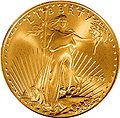
Other aureate bullion coins, many named after their design features, include:
- Austrian Philharmonic
- British Britannia
- Canadian Maple Leaf
- Chinese Panda
- Gold Dinar
- Malaysian Kijang Emas
- Russian Chervonets
- Russian George the Victorious
- Swiss Vreneli
- French Napoleon
- Australian Gilt Nugget
- South African Krugerrand
- Iranian Leap of Freedom
Fineness [edit]
Circulating gold coins were unremarkably made of an alloy as other metals are mixed into the money to make information technology more durable. Fineness is the actual gold content in a coin or bar and expressed as a "per mil", or thousandths. For example, a gold ingot or coin identified as existence .999 fine will be 999/yard pure gold, with the other 1/yard being impurities.
Crown gilded is the proper name given to .9167 (or 22-karat) fine gold used in sovereigns and American aureate eagles. Meanwhile, the Us have historically struck gold coins with .900 fine gold. Virtually bullion coins are minted from .999 or finer gold.
Counterfeits [edit]

Remainder for checking the weight of gold coins
For nigh of history, coins were valued based on the precious metallic they contain. Whether a coin was actually made past the party as claimed was of secondary importance compared to whether it contains the right corporeality of metal – that is, correct weight and fineness (purity). Genuine appearance was simply a user-friendly shortcut to avoid time-consuming tests in everyday transactions.
Gilded is denser than almost all other metals, hence hard to fake. A decision of weight and volume is in many cases sufficient to spot forgeries. A money that is not gold or below the expected fineness will either have the right size but volition accept a lower than expected weight or it weighs right and will be somewhat larger. Virtually metals that are of similar or higher density than gold are similarly or more expensive, and were unknown in aboriginal times (notably the platinum group). During the 19th century platinum was cheaper than gilded and was used for counterfeiting gold coins. These coins could be detected by audio-visual properties.[8] Only 2 relatively inexpensive substances are of like density to gold: depleted uranium and tungsten.[ix] Depleted uranium is government-regulated, but tungsten is more commonly bachelor and suited for counterfeiting.[9] Alloying golden with tungsten would not piece of work for several reasons, but tungsten plated with a sparse layer of gilded is a mutual type of forgery.
Bullion money counterfeits (of all types) used to be rare and fairly easy to observe when comparing their weights, colors and sizes to authentic pieces. This is because the price of reproducing any given coin precisely tin can exceed the market value of the originals.[10] [11] [12] [xiii] Yet, since virtually 2015 counterfeit coins are "flooding the marketplace at an astonishing charge per unit" and "it's gotten to the point where even people who deal with coins all the time may not exist able to recognize a counterfeit coin right abroad" (American Numismatic Association (ANA), 2016).[fourteen] The coins consist by and large of tungsten plated thinly with gold, have the correct weight, correct or well-nigh-correct dimensions and are professionally produced in People's republic of china.[14] [fifteen]
The weight and dimensions of a money of .999 fineness such as the Maple Leaf cannot be replicated precisely by a golden plated tungsten core, since tungsten has only 99.74% of the specific gravity of gold. Still, forgeries of alloyed gold coins (such as American Golden Eagle or Krugerrand made from a crown aureate alloy with 22 karats = .917 fineness) may accept correct the correct weight and dimensions because of the lesser density of the alloy. Such forgeries can exist detected testing the acoustic, electric resistance or magnetic properties. The latter method uses the fact that aureate is weakly diamagnetic and tungsten is weakly paramagnetic. The effect is weak and then that testing requires strong neodymium magnets and sensitive weather condition (e.g., a gold money hanging from 2 m long pendulum or placed on styrofoam floating on water), such tests can be performed without special equipment.[16] Forgeries using gold plated tungsten are too used in counterfeiting of gold bars.
Bitter gold [edit]
The rationale for bitter a money was the supposed widespread dissemination of gold plated lead coins in the 19th century.[17] Since pb is much softer than aureate, bitter the coins is a sensible examination for counterfeiting.[17] While fine gold is softer than assimilated gold, and galvanized pb is softer, biting coins can just find the crudest of forgeries.[17] And all "golden" coins minted for circulation in the UK and America since the Tudor menstruum (1485–1603) contained copper which made them more durable and thus hard to bite.[17]
Biting a coin to determine whether it is 18-carat or counterfeit is a widespread cliché depicted in many films (like the 1917 The Immigrant), books (like the 1925 L'Or by Blaise Cendrars) and plays (like the 1938 Female parent Courage which is set in the Thirty Years' War 1618–1648).[17] Co-ordinate to a 2017 study, the causeless widespread practice of pirates biting into a coin is virtually certainly a Hollywood myth.[17]
Olympic champions often pose biting their gold medals,[ why? ] even though the medals are no longer fabricated of solid gilt.[17] [18] [ clarification needed ] Simply at three Olympics (in 1904, 1908 and 1912) were medals made of solid aureate, but were also smaller.[eighteen] David Wallechinsky commented in 2012 that "It's go an obsession with the photographers. I think they await at it as an iconic shot, as something that you can probably sell. I don't think it'south something the athletes would probably practice on their own."[18]
Numismatic fake samples [edit]
There are well made apocryphal aureate coins in apportionment. For example, the St. Gaudens Double Eagle omega counterfeit is infamous for its complexity[19] and has fooled many numismatics experts.
Some other case is the US $20 gold money ("double eagle"), which has raised lettering effectually its rim. If the coin is uncirculated, the letters will exist flat on summit. If slightly rounded, and the money is uncirculated, it is a counterfeit. There are other counterfeit double eagles in which the gilded and copper alloy was not thoroughly mixed. These counterfeits will have a slightly mottled appearance.[20]
Meet as well [edit]
- Counterfeit
- Gilded bar
- Gold equally an investment
- Gold standard
- Silver money
- Palladium money
- Platinum coin
- History of coins
- Numismatics
- Latin Monetary Wedlock
- Euro gold and silver commemorative coins
- Sycee
References [edit]
- ^ "Gold coins – A Brief History".
- ^ "Monetary Episodes from History".
- ^ Lewis, Paul (August xv, 1976). "Nixon's Economical Policies Return to Haunt the G. O. P." The New York Times.
- ^ a b "The Million Dollar Coin – a truthful milestone in minting". Royal Canadian Mint. Archived from the original on January 25, 2015. Retrieved 25 January 2015.
- ^ "Giant gold money with Queen's caput stolen from Berlin museum". March 27, 2017.
- ^ a b "Investment Gold Coins".
- ^ "The Biggest Aureate Coin in the World". Perth Mint, Australia. Archived from the original on January 25, 2015. Retrieved 25 Jan 2015.
- ^ Manas, Arnaud (2015). "The music of gold: tin can gold counterfeited coins be detected by ear?". European Periodical of Physics. 36 (four): 045012. Bibcode:2015EJPh...36d5012M. doi:10.1088/0143-0807/36/4/045012.
- ^ a b Gray, Theo (March xiv, 2008). "How to Make Convincing Fake-Gilt Bars". Popular Science. Archived from the original on January 25, 2015. Retrieved 2008-06-18 .
- ^ "Counterfeit Money Detection".
- ^ "Apocryphal gold coins and bars". Archived from the original on January 29, 2013.
- ^ Sargent, Mike. "Indian Caput Quarter Eagles: King of the Counterfeit Gold Coin Serial" (PDF).
- ^ Lafleur, Merlin. "Fake gilded bars out of tungsten a counterfeit story".
- ^ a b Herb Weisbaum 2016. Glitters, but Non Aureate: Fake Gold and Silver Coins 'Flooding' Marketplace. nbcnews JUN 13 2016, https://www.nbcnews.com/business/business-news/glitters-not-gilded-fake-gilded-argent-coins-flooding-market-n591201
- ^ Archived at Ghostarchive and the Wayback Auto: "Sehr gut gefälschte Goldmünzen: Echtheitsprüfung für Krügerrand, Maple Leaf und American Hawkeye". YouTube.
- ^ Archived at Ghostarchive and the Wayback Machine: "Examination Tungsten / Wolfram Fälschungen von Krügerrand-Goldmünzen prüfen". YouTube.
- ^ a b c d e f thou Manas, Arnaud (2017). "Why practice pirates bite gold coins they are given? (PDF Download Bachelor)". ResearchGate. doi:ten.13140/rg.2.2.27019.08487.
- ^ a b c Melonyce McAfee. Why Olympians bite their medals at the Wayback Machine (archived April 16, 2018) CNN, 10 August 2012.
- ^ Roberts, John. "The 1907 Loftier Relief Saint-Gaudens Double Eagle". ANACS. Archived from the original on February iv, 2016.
- ^ "How Can You Know If Gold is Simulated or Real?".
Farther reading [edit]
- Robert Friedberg, Gold Coins of the World: From Aboriginal Times to the Present – An Illustrated Standard Catalogue with Valuations (Coin and Currency Constitute, 2003) ISBN 978-0-87184-307-4
External links [edit]
 | Wikimedia Commons has media related to Golden money. |
- U.s.a. Mint: American Eagle Bullion Coins at the website of the United States Mint, U.s.a. Department of the Treasury
- The Royal Mint: United kingdom bullion coins at the website of The Majestic Mint
Source: https://en.wikipedia.org/wiki/Gold_coin
0 Response to "How Can I Sell My 21/2 Dollar Gold Coin Nassau County Ny Upload My Coins"
Post a Comment